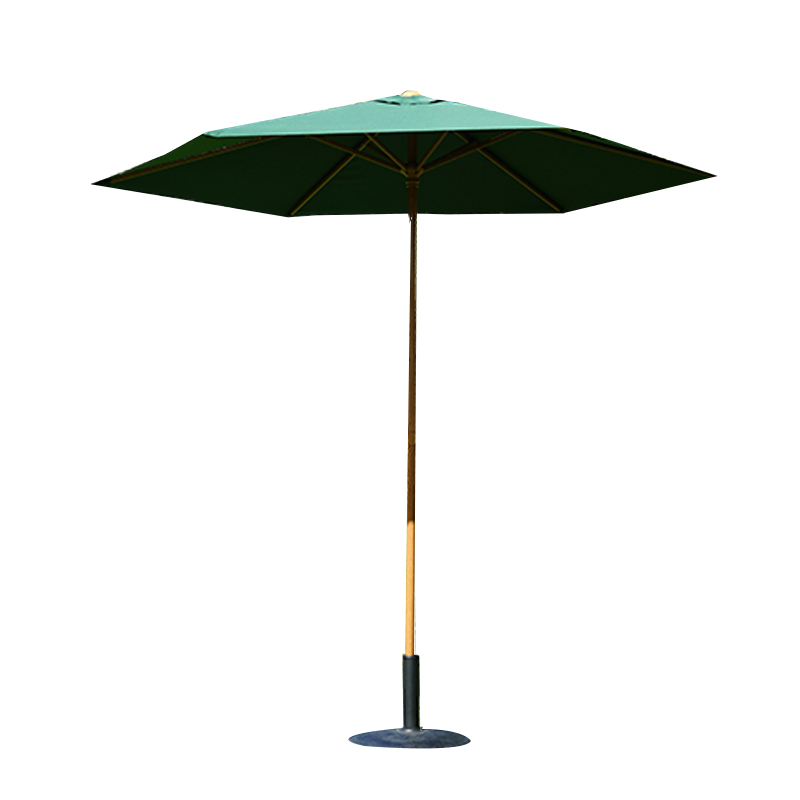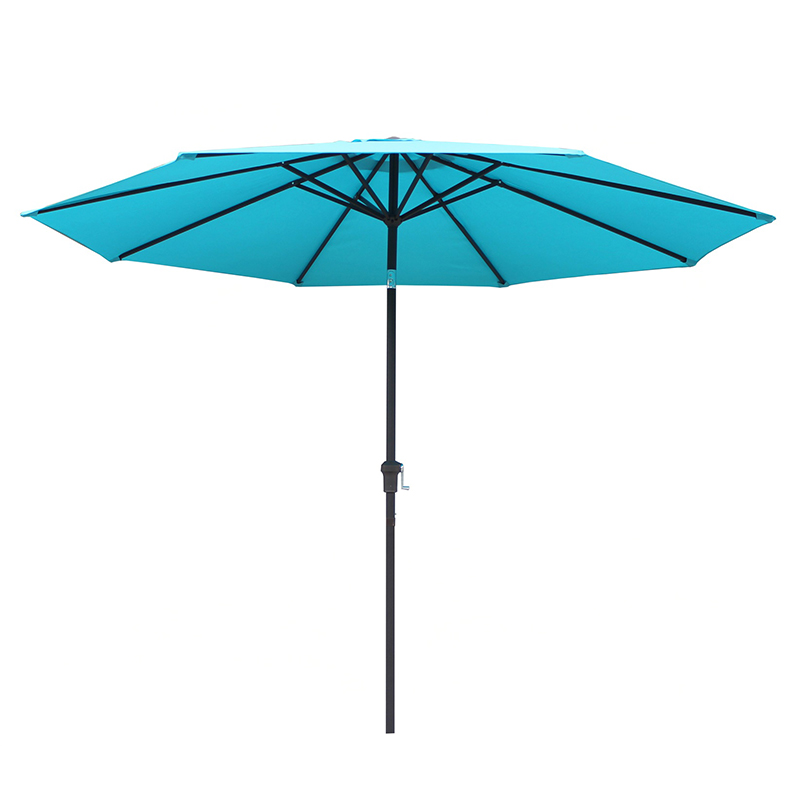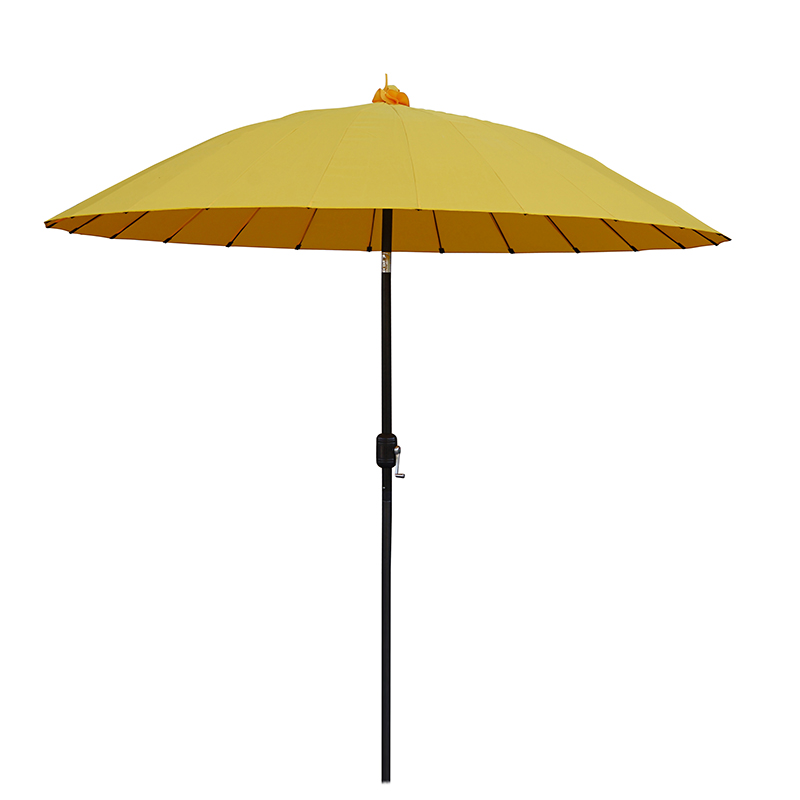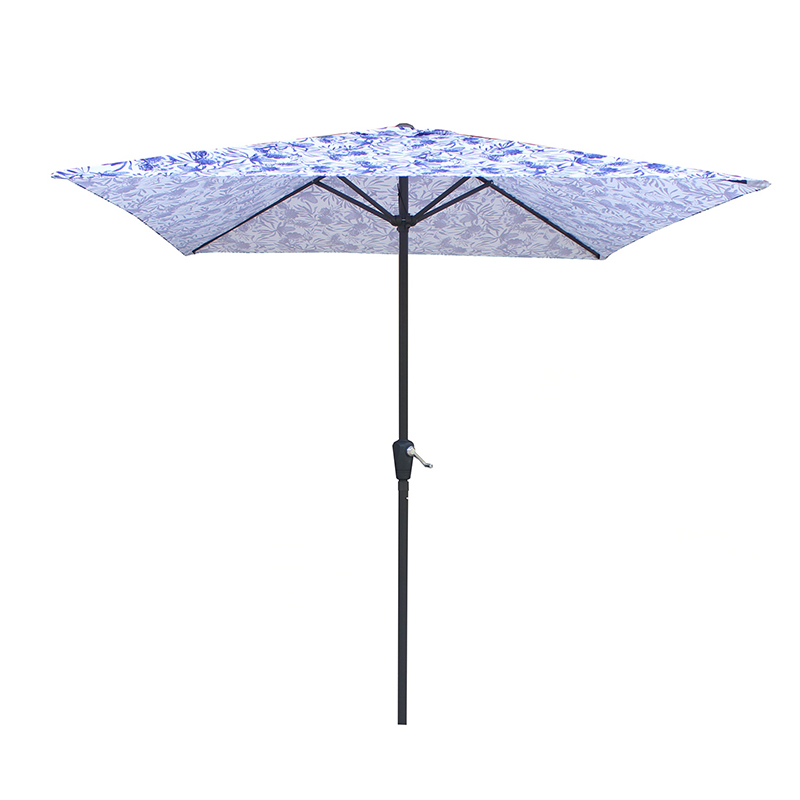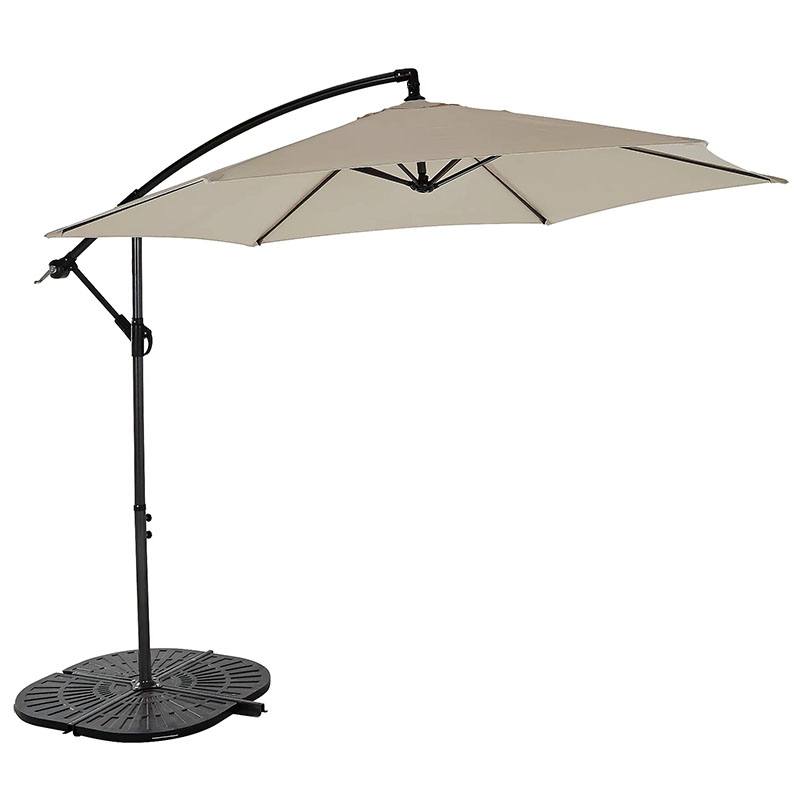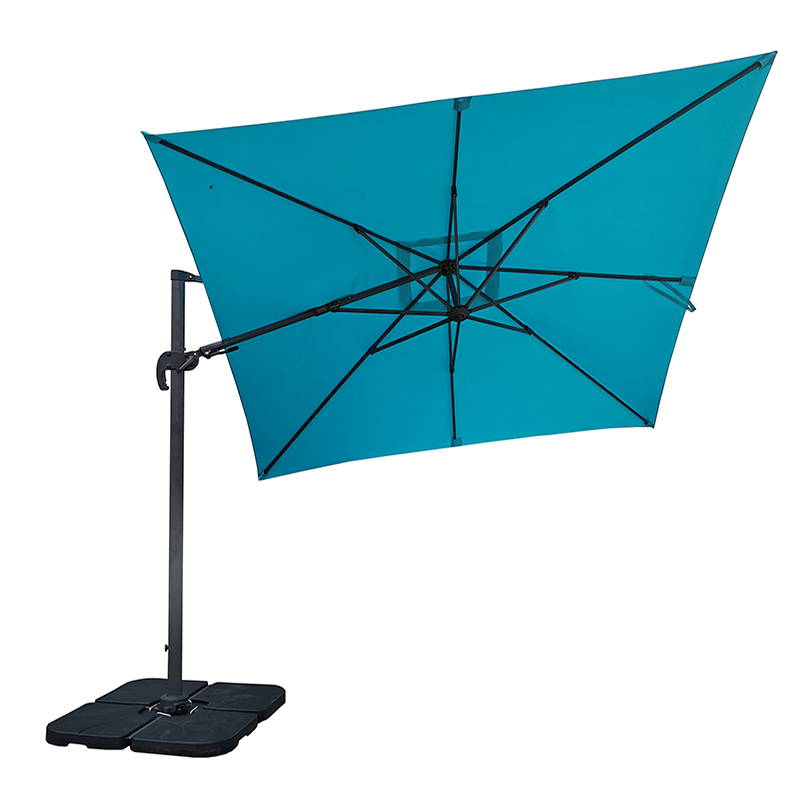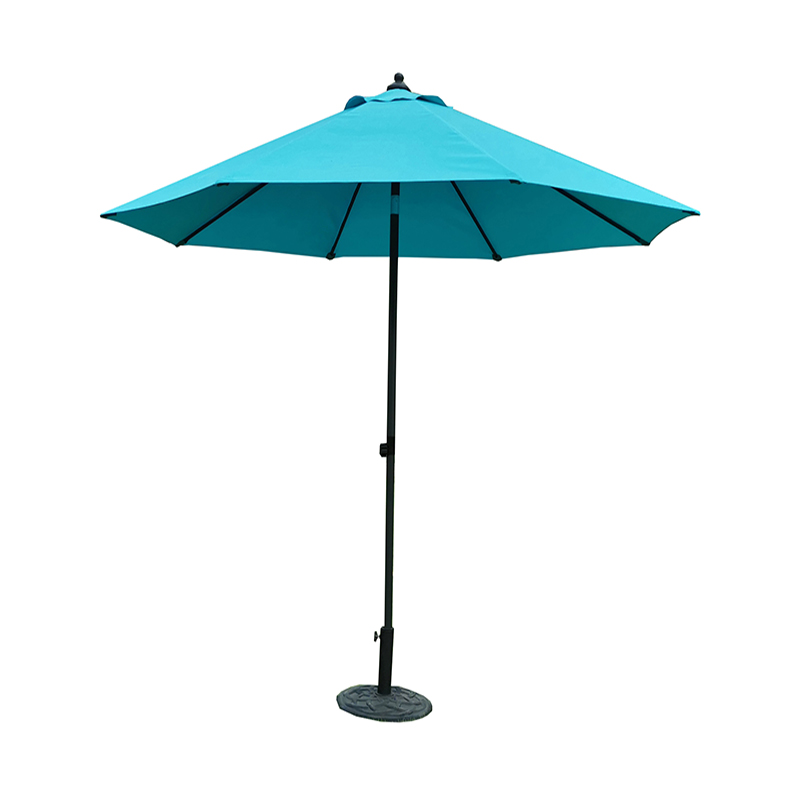
A big patio umbrella stays upright when the base mass matches the canopy's sail area. The practical rule: a 10 ft (3 m) center-pole umbrella on an open patio needs roughly 25-35 kg of base, while a cantilever umbrella of the same span needs 90-120 kg, because its weight sits beside the pole instead of directly under it.
A big patio umbrella with base means a shade set of 2.7 m (9 ft) or more in diameter, supplied or specified together with a base plate, cross base, or fillable weight block. Buying the two as one package matters more than it sounds, because an umbrella's wind rating only holds when the base it was tested with is the base you actually install.
Three facts cover most of the decision:
- Shade grows with the square of the diameter, so a 13 ft canopy covers roughly twice the area of a 9 ft one.
- Required base weight scales with canopy area and wind exposure, not with the umbrella's price.
- Mounting type sets the multiplier: cantilever and Roma umbrellas need three to four times the base weight of a center-pole model.
What Counts as a Big Patio Umbrella
From 2.7 m upward you are buying shade by area, not by diameter, and each size step adds more than most buyers expect. A 9 ft canopy sounds only 30% wider than a 7 ft one, but it delivers roughly 65% more shade, which is why the base requirement jumps at the same time.
| Canopy size | Approx. shade area | Typical setting | Center-pole base | Cantilever base |
|---|---|---|---|---|
| 9 ft / 2.7 m | 5.9 m² | 4-seat bistro table | 20-25 kg | 60-80 kg |
| 10 ft / 3.0 m | 7.3 m² | 6-8 seat dining table | 25-35 kg | 90-110 kg |
| 11.5 ft / 3.5 m | 9.6 m² | Lounge set or double sunbed | 35-45 kg | 110-140 kg |
| 13 ft / 4.0 m | 12.3 m² | Restaurant terrace, hotel pool deck | 45-60 kg | 140-180 kg |
Two practical consequences follow. First, measure the table or lounge footprint before choosing the canopy: a 3 m umbrella over a 1.5 m table leaves comfortable clearance, while the same umbrella over a 2.2 m table forces guests to duck under the ribs. Second, if the site is coastal, rooftop, or a corner between buildings where wind accelerates, use the upper end of the base range and treat the lower figure as an indoor or fully sheltered number only.
Base Weight: The Number That Decides Whether It Stays Up
Base weight, not canopy quality, is what decides whether an umbrella survives its first serious gust, so specify the base before you fall in love with a frame. Four base families cover almost every large umbrella on the market:
- Steel or cast plate bases - dense and compact, typically 20-50 kg in one piece. Best on paved terraces where the base can sit flat and be moved with a trolley.
- Fillable HDPE bases - empty weight of 4-8 kg, then filled on site. A 60 litre cavity holds about 60 kg of water or roughly 90-95 kg of dry sand, and sand is the better choice where the base will not need to be emptied often.
- Cross bases with pavers - the cheapest route to mass, but the slabs are loose, they shift, and they are the single most common cause of a tipped umbrella on a windy terrace.
- Ground sleeves and anchor plates - fixed installations for grass, sand, or permanent hospitality layouts.
Check the filled weight in the specification, not the carton weight. A base advertised as "heavy duty" that ships at 9 kg is a shell, and a water-filled shell on a 13 ft canopy is a lever waiting for the right gust. Also confirm the hub and pole diameter: 38 mm and 48 mm poles use different collars, and a base that fits one will wobble on the other.
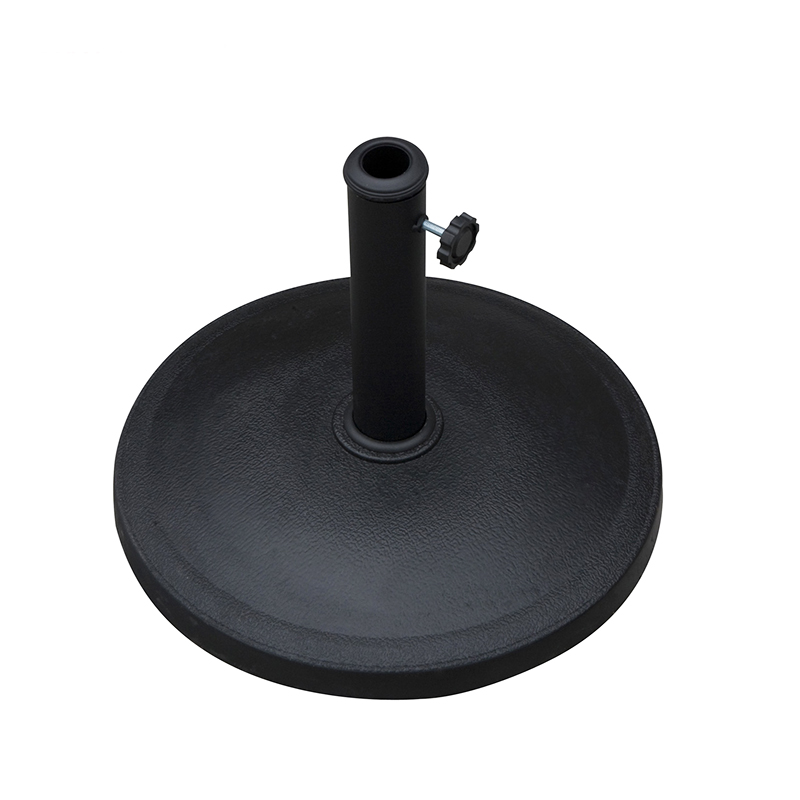 UA1919 Resin Base for Straight UmbrellasA 10 kg resin base for straight umbrellas, with an anti-slip pad and center-pole fit; useful when comparing filled weight and pole diameter.View Product →
Center Pole, Cantilever or Roma: Where the Weight Sits
The mounting type decides how much base you need, because every design except the center pole moves the load away from the footprint that supports it. A cantilever carries the canopy on a side arm, so the base has to resist a turning moment rather than a vertical push, which is why the same shade area demands three to four times the mass.
| Mount type | Where the base sits | Base weight, 3 m canopy | Best for |
|---|---|---|---|
| Center pole with cross base | Under the table, around the pole | 25-35 kg | Dining sets, compact patios, lowest cost per kg of stability |
| Cantilever / offset | To one side of the seating | 90-120 kg | Lounge groups, uninterrupted table space, adjustable tilt |
| Roma (side-post, double tier) | Beside the pole, larger plate | 80-110 kg | Hospitality terraces, hot climates, strong vertical venting |
| Double-sided / rectangular | Two posts or a wide twin plate | 50-70 kg total | Long tables, pool edges, market stalls |
The trade-off is straightforward. A center-pole umbrella is the most stable per kilogram and the cheapest to ship, but the pole runs through the middle of the table and the base eats foot room. A cantilever frees the whole seating area and tilts easily, at the cost of a heavy plate or a 1/4-plate system that must be bolted or ballasted properly. For a large cantilever frame, choose one with a rotating hub and a lockable tilt so the canopy can be swung out of the wind rather than fought.
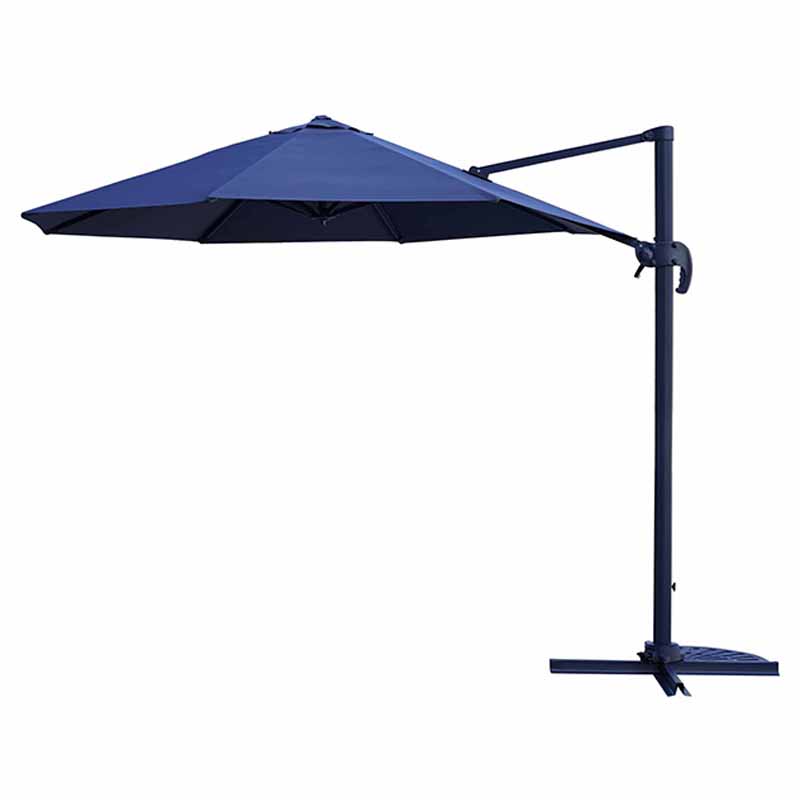 GP1931 Roma Cantilever Outdoor ParasolA fixed-canopy cantilever parasol in 3.0 m or 3.5 m with 200 g polyester cover and aluminum frame; review fabric and frame details before choosing.View Product →
Frame, Ribs and Fabric: What Ages First
The base keeps the umbrella upright, but the frame and fabric decide how many seasons you get, and on large canopies the fabric usually fails before the metal does. Points worth checking on any big patio umbrella:
- Pole and ribs - aluminium in 1.5-2.0 mm wall thickness resists rust and stays manageable in weight; powder-coated steel is stronger per dollar but depends entirely on coating integrity. Coating thickness of 60-80 microns is a fair benchmark for outdoor use.
- Rib count and joints - eight ribs distribute canopy tension better than six on 3 m and larger spans, and fibreglass ribs survive bending that snaps steel.
- Fabric weight - 200-260 g/m² polyester with UV treatment is the common commercial grade; solution-dyed acrylic holds colour longer under strong sun. Lighter 160-180 g/m² fabric is a one-to-two-season choice on a large canopy.
- Wind vent - a top vent or double-tier canopy lets air pass through and measurably reduces lift, which is the force that tips bases in the first place.
- Mechanism - crank, push-up, or auto-open, plus tilt range. On a 13 ft canopy a crank with a metal housing is worth the upgrade over plastic.
Placement: Slab, Deck, Grass or Sand
The surface under the base changes the anchoring plan more than the umbrella model does, so read the site before finalising the order. A base that is perfect on a concrete slab can be useless on a timber deck or loose sand.
- Concrete or stone slab - weight alone is enough for most center-pole sets; add rubber pads to protect the surface and stop the plate creeping.
- Timber deck - spread the load with plywood pads or a wide plate, and never rely on a small foot that dents the boards; through-bolting into joists is an option on permanent installations.
- Grass or soil - a ground sleeve or auger anchor outperforms loose ballast, because soil gives way under a shifting plate.
- Sand and beach edges - use a wide cross base combined with a sand anchor or auger; a flat plate on dry sand will sink on one side within a season.
- Balconies and terraces - keep the canopy two sizes below what the floor area suggests, and add a railing tie where regulations allow it.
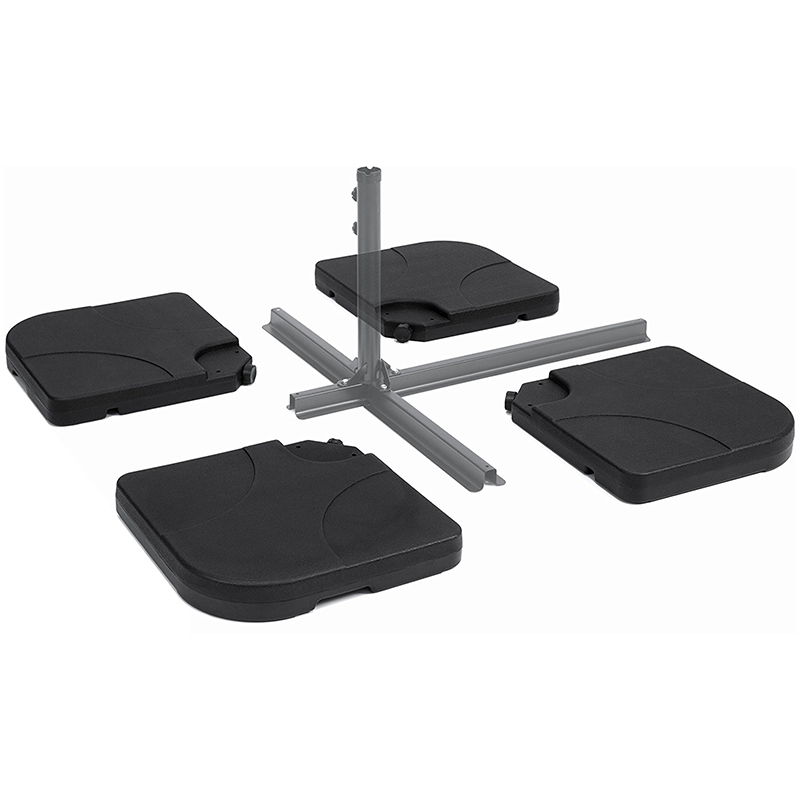
For cantilever sets, the base plate is usually supplied as four quarter-plates that bolt together. That design is easier to carry and to ship, but each bolt must be torqued and re-checked after the first week of use, since vibration loosens the joints that hold the whole arm upright.
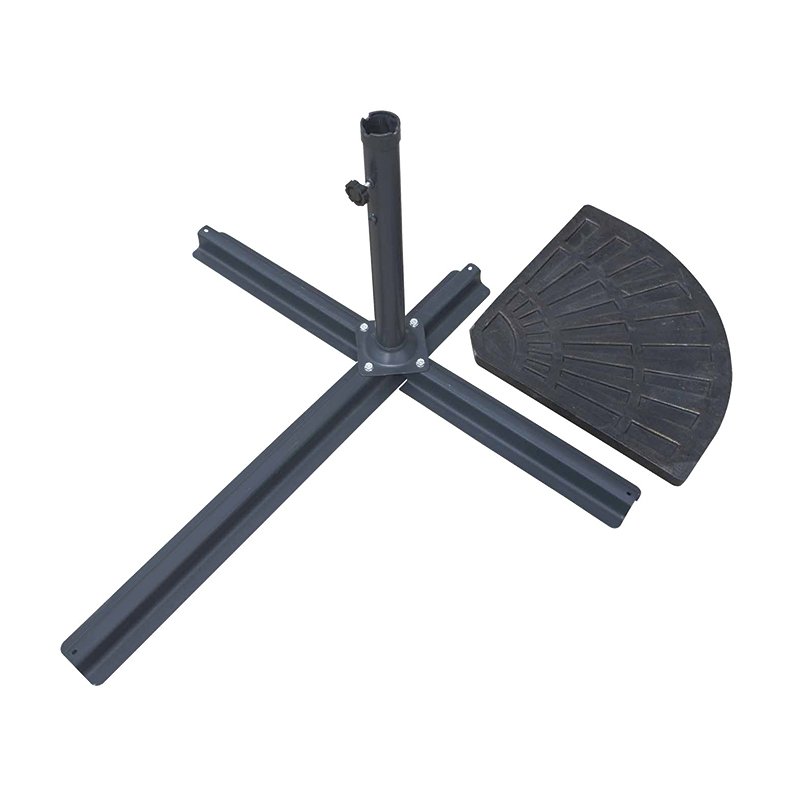 UA1917 Quarter Base for Cantilever UmbrellasA 12 kg resin quarter-plate base for cantilever umbrellas, with a central metal pole interface; consider filled weight and assembly checks when specifying a set.View Product →
Procurement Checklist for Bulk Buyers and Specifiers
Specify a big patio umbrella with base by filled weight, carton volume and tested wind rating, not by adjectives such as "heavy duty" or "commercial grade". A short checklist keeps samples and production aligned:
- State the canopy diameter, shape, and mounting type in the purchase order, plus the pole diameter for base fitting.
- Require the filled base weight on the spec sheet, and confirm whether the cavity is rated for water, sand, or both.
- Ask for the carton dimensions and gross weight per set, since base volume usually drives container loading far more than canopies do.
- Confirm fabric weight in g/m², UV treatment, and colour fastness, especially for sunny or coastal markets.
- Agree on spare parts: ribs, crank handles, hubs, and base bolts are the items that fail first in service.
- Check process control evidence, such as coating thickness records and in-line inspection points, rather than relying on a final visual check.
On mixed orders it is usually cheaper to pair a standard canopy with a locally stocked base than to ship matched sets, but only if the base is rated for the canopy area and the pole collar matches. The base sizing questions buyers ask most often are collected in this guide to choosing the right base for a patio umbrella. Where dimensions, fabric colour, or branding need to change, custom patio umbrella production allows the canopy, frame and base to be developed as one tested assembly instead of three separate purchases.
FAQ
How much does a big patio umbrella with base weigh in total?
A 3 m aluminium center-pole umbrella typically weighs 12-18 kg, so with a 30 kg base the delivered set lands around 45-50 kg. A 3 m cantilever set with a 100 kg plate is closer to 130 kg, which is why the two are handled as different installation projects.
Can I use a big umbrella on a windy balcony?
Yes, but size down. A 2.5 m canopy with at least 20 kg of base and a railing tie is a realistic limit for an upper-floor balcony, and cantilever models are a poor fit there because the arm catches wind well above the floor.
Will a fillable base scratch or stain the patio?
Not if it is HDPE or polyresin with moulded feet. Steel plates and concrete blocks are the ones that mark paving, so put rubber pads underneath and lift rather than drag the base when repositioning it.
Does a top vent really help in wind?
Yes. A vent or double-tier canopy lets air escape upward and reduces the lift that tips a base, and the effect is most noticeable on canopies of 3 m and larger. It does not replace base weight, but it buys margin during gusts.